Executive Director
If You Fund It, They Will Come
In our new report, If You Fund It They Will Come, Keystone Research Center and ReImagine Appalachia reveal that federal investments in clean energy have catalyzed a major economic transformation across Appalachia, doubling clean energy investments in just one year. We show that public funding through landmark legislation such as the Inflation Reduction Act (IRA), the Infrastructure Investment and Jobs Act (IIJA), and the CHIPS and Science Act has spurred significant private investment, leading to billions of dollars in new energy and manufacturing projects across Kentucky, Ohio, Pennsylvania, and West Virginia.
Key Findings:
- Federal clean energy investments in Appalachia grew 17-fold between 2022 and 2024, totaling $11.5 billion across Kentucky, Ohio, Pennsylvania, and West Virginia.
- These investments triggered a doubling of public and private clean energy spending in the region, increasing from $7.7 billion in 2022 to nearly $15.9 billion in 2023 and continued increases in 2024 Q1
- Most congressional districts in the four-state region have benefited from clean energy investments between 2022-2024, ranging between $1 million and $5.7 billion.
- The $11.5 billion in federal investment in our four states from 2022 to 2024 represents a relatively small share of total investment of just over $40 billion tracked in the Clean Investment Monitor over the same period with private investment in clean energy technologies somewhere between 3 and 4 times larger than that of public investment. Most of the capital invested in clean energy comes from private sources, which is incentivized with those funds attracted in by federal tax credits, grants, loans and loan guarantees.
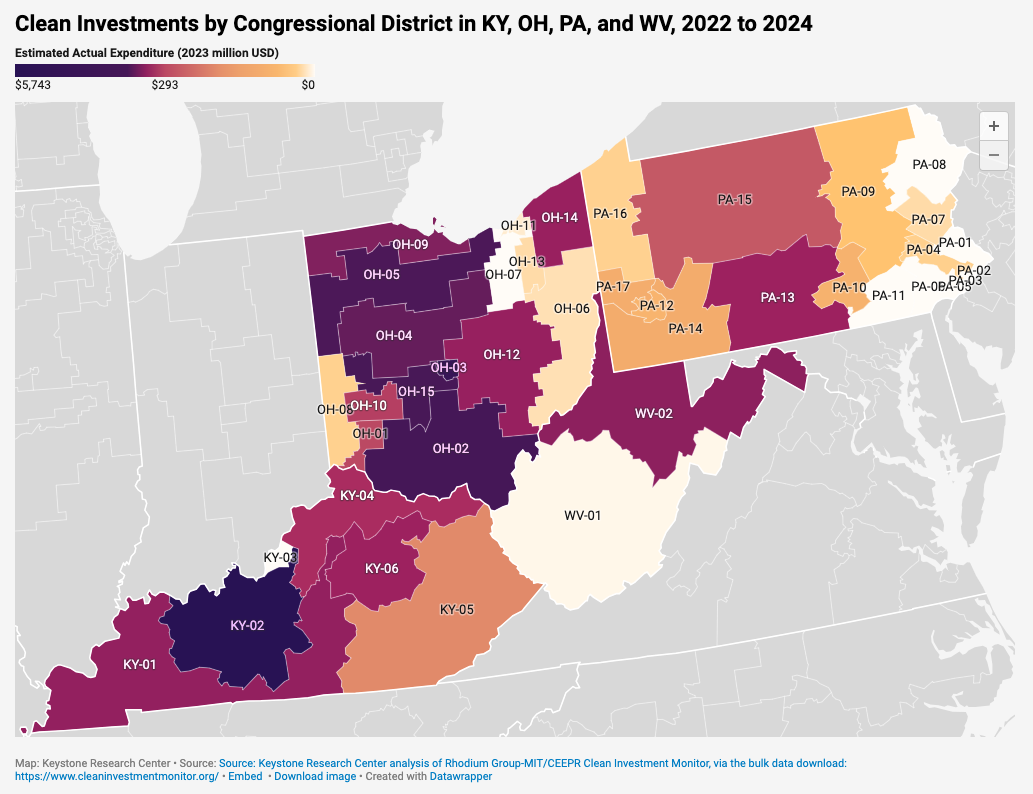
Historically impacted by the decline of manufacturing and extractive industries, Appalachia is now emerging as a hub for clean energy and advanced manufacturing. The IRA and IIJA have been instrumental in reversing economic stagnation, attracting private sector investment, and strengthening local economies.
However, the report warns that this progress is at risk. The continued growth of clean energy investment depends on maintaining federal support.
Blogs and Statements
American Solidarity Forever – May Day Yesterday and Today
This blog commemorates May Day by tracing its roots to the U.S. labor movement, particularly the 1886 fight for the eight-hour workday and the Haymarket affair. It calls for renewed solidarity to address today’s worker challenges like low wages and unsafe conditions.
This post highlights how federal clean energy investments have sparked over $23 billion in projects across Appalachia, creating thousands of jobs. It shows bipartisan benefits, with both red and blue districts seeing economic gains from climate and infrastructure policies.
STATEMENT: KRC on PA Jobs Report – March 2025
With the release of Pennsylvania’s March 2025 employment situation report by the Department of Labor & Industry, KRC Executive Director Stephen Herzenberg highlighted that the commonwealth’s job market remains exceptionally strong, with nonfarm employment at record high levels and the unemployment rate holding steady below the national average. He noted that wage growth continues to outpace inflation, restoring workers’ purchasing power and signaling a sustained “worker-friendly” labor market. KRC cautioned, however, that continued momentum depends on policies that support full employment and equitable growth.
Pennsylvania’s job market remains strong, with record-high nonfarm employment and low unemployment. Wages are rising faster than inflation, but KRC warns continued progress depends on pro-worker policies.
 The Labor Movement and Earth Day – A Retrospective
We trace Earth Day’s origins to April 22, 1970, when UAW President Walter Reuther and other union leaders provided crucial funding and logistics for what became one of the largest mass demonstrations in U.S. history. We show how unions—from SEIU to UFCW—embraced environmental protection as a workplace safety and public-health issue, giving rise to today’s “just transition” framework that pairs climate action with worker supports. The blog underscores labor’s influence on the Inflation Reduction Act’s labor standards and highlights unions’ current role in shaping clean-energy policy to ensure good, union jobs accompany any shift to a greener economy.
Unions played a key role in launching Earth Day and have long linked environmental issues to workplace safety. Today, labor remains central to ensuring climate policy includes strong job protections.
Union Organizing in the Southern Auto Industry and Beyond: An Update
We provide an update on UAW efforts in the U.S. South, highlighting the landmark April 2024 vote in which 73% of workers at VW’s Chattanooga plant won union representation—an achievement long thought impossible in that region. Despite the narrow setback at Mercedes-Benz’s Tuscaloosa plant, there is great reason to believe that anti-union culture in the South is showing signs of erosion. We also note a parallel win by the United Steelworkers at EOS Energy in Turtle Creek, PA, illustrating momentum for organized labor in both auto manufacturing and clean-energy supply chains. Keep the pressure on!
The UAW’s breakthrough at VW Chattanooga marks a turning point for labor in the South, despite setbacks like the Mercedes vote. Wins in clean energy, like at EOS Energy in PA, signal broader momentum.
Workers are Players Too – How Organized Labor Build Major League Baseball
We examine baseball’s evolution from an agrarian pastime to a multibillion-dollar industry, showing how early players organized against restrictive salary caps and the reserve clause through groups like the Brotherhood of Professional Baseball Players in 1885. Spotlighting Marvin Miller’s transformative leadership of the MLBPA beginning in 1965—securing the first collective bargaining agreement in sports history, the right to arbitration, and ultimately free agency in 1974—which shifted power from owners to players and ignited unprecedented wage growth. Without organized labor, we wouldn’t have today’s robust CBAs – which continue to protect players’ rights, ensuring athletes share equitably in the sport’s economic success.
Organized labor shaped pro baseball, from early resistance to unfair pay rules to securing free agency under Marvin Miller. These wins laid the foundation for today’s powerful player unions and fairer compensation.
KRC in the Media
Public News Service: Federal clean energy funds double climate investments in PA – Danielle Smith
Diana Polson, senior policy analyst at the Keystone Research Center, said the funding for clean-energy projects from the Inflation Reduction Act and Infrastructure Investment and Jobs Act is helping to revive Pennsylvania’s middle class, hit hard over decades by job losses in manufacturing and coal.
Polson said rural areas have seen an incredible amount of investment. Pennsylvania’s 13th District, which overlaps the Southern Alleghenies, saw $754 million spent on multiple solar and wind projects.
HARRISBURG, PA – Senator Tartaglione has introduced a bill designed to raise the Commonwealth’s minimum wage to $15 per hour by next year, with annual cost-of-living adjustments thereafter.
Keystone Research Center estimates that raising the minimum wage will have an impact, directly or indirectly, on more than 1.3 million Pennsylvania workers, many of whom are in essential industries such as home health care, childcare, retail, and hospitality. These workers, who help keep Pennsylvania running, deserve more than poverty wages.
It sounds like a modern take on a dystopian doctoral thesis: studying the physical and psychological effects of rapid, repeated and unexplained downgrading of key infrastructure on the lives of those responsible for maintaining it and those whose lives depend on it.
Stephen Herzenberg, an economist and executive director of the Keystone Research Center, told City & State that while many higher education institutions may have some “administrative bloat” and increasing overhead costs, the White House is “taking the approach where it’s hard to believe they’re not going to throw out a lot of babies with some of the bathwater. – Competitiveness is going to be compromised,” Herzenberg said.
WDAC – Another Try to Raise PA’s Minimum Wage – Greg Barton
At $7.25 an hour, PA’s current minimum wage remains at the federal floor, unchanged since 2006. A total of 30 states have taken action to raise their minimum wages.
According to estimates from the Keystone Research Center, over 1.3 million Pennsylvanians would see their wages rise directly or indirectly under the proposal. Such workers are overwhelmingly adults, many of whom serve in essential roles such as home health aides, childcare providers, grocery clerks, and restaurant servers.