Wages have risen, but so have prices. How does this shake out for a typical Pennsylvania worker?
In this blog, we show that PA workers’ wages have risen faster than inflation in recent years.
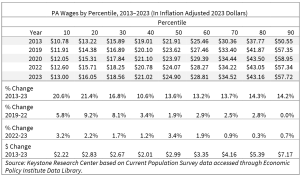
Table 1 shows that workers throughout the PA earnings distribution saw their inflation-adjusted wages rise by at least $2 per hour from 2013-2023. This adds up to $4,160 dollars per year for someone working full-time, full year. Lower-wage PA workers enjoyed a robust 20% wage increase over the past decade, or around 2% per year.
Table 1 also shows that PA wages have consistently beat inflation in recent years, even including the inflation spike of 2021-2022. Since 2019, workers in the bottom 30% of the earnings distribution saw the highest percent wage gains from 2013 to 2023—17% to 22%. Between 2019 and 2023, (before the pandemic up to last year), the lowest-paid 30% of PA workers saw their wages increase by roughly 10 percent or between $1.09 per hour (at the 10th percentile) and $1.67 per hour (at the 30th percentile) (Table 1). For these workers, and workers up to the 80th percentile, the answer to the question “are you better today than four years ago?” is a clear “Yes” measured by hourly earnings.
Table 1
Unsurprisingly, PA’s lower-wage workers are not doing as well as they would if Pennsylvania or U.S. lawmakers would increase the minimum wage in our state or nation from the current paltry $7.25 per hour. The Pennsylvania and United States’ $7.25 per hour minimum wage now almost exactly matches the poverty wage of $7.24 per hour—the amount that a single individual needs to earn per hour for 52 40-hour work weeks to reach a poverty income. Researchers at MIT estimate that the lowest “living” wage needed to get by in any PA county for a single adult with zero children is $18.59 per hour, over two-and-half times higher than the current minimum wage. Nearly a third of Pennsylvania workers earn below that living wage level (see Table 1 above).
Figure 1
More than a million Pennsylvania workers would benefit from a $15 per hour Pennsylvania minimum wage. This includes 403,000 Pennsylvania workers who earned $12 per hour or less in 2023, and another 467,000 who earned $12-$15. Some workers earning above $15 per hour would also benefit because their employers would give them a raise to maintain some differential with the new minimum wage.
Research by the Keystone Research Center and others shows that women and people of color would benefit especially from a minimum wage increase because they make up a disproportionate share of the lowest-paid workers in our Commonwealth. Just over 60% of those who would benefit from an increase to $15 per hour by 2026 would be women, and just shy of one-third who benefit would be people of color (31.4%). In total, an estimated 1.35 million Pennsylvania workers would benefit from a minimum wage increase to $15 per hour in Pennsylvania.
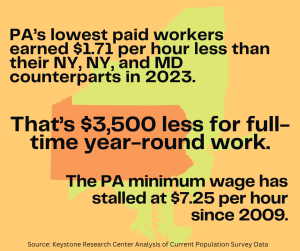
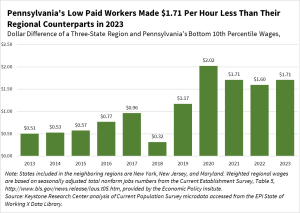
Every state that borders Pennsylvania pays a higher minimum wage, with New York, New Jersey, and Maryland paying workers at least $15 per hour. Pennsylvania workers have watched as 30 states and the District of Columbia have raised their minimum wage—some, many times. Progress has stalled on the minimum wage in the Pennsylvania legislature for a decade and a half, despite repeated proposals for increases from Democratic Governors and support for an increase from virtually all Democrats. Meanwhile, with the minimum wage still stuck at $7.25 per hour, too many Pennsylvania workers struggle to afford the basics, and anti-poverty assistance effectively subsidizes low-wage employers. Lawmakers’ failure to increase the minimum wage makes a big difference for Pennsylvania workers earning low wages. Figure 2 shows the dollar difference between PA’s 10th percentile earners and their counterparts in adjacent states of New York, New Jersey, and Maryland since these states began increasing their minimum wage (with New York going first starting in 2013). In 2023, Pennsylvania workers were paid $1.71 per hour less than workers in these three neighboring states. For a full-time, full-year worker, $1.71 per hour adds up to $3,567. That’s a substantial amount of money for a low-income family.
Figure 2
Keystone Research Center released its annual report on the economy “State of Working Pennsylvania 2024” on August 27th. This is the sixth of a series of blogs focused on smaller, more digestible, pieces of our report. To access the full report, including full references for this specific blog, and other “State of Working Pennsylvania” resources, please visit our 2024 State of Working Pennsylvania Resource page here.