The Upshot:
The Governor unveiled his budget yesterday, framing it against a fragile national economy shaped by federal policy: uncertainty fueled by erratic tariff policies, slowing job growth nationally (but less so in PA), uncertainty around federal employment, and declining consumer confidence. To offset reduced federal aid (e.g., for Medicaid in 2027), he urges the commonwealth to step-in and proposes greater investments in PreK–12 and special education, mental health services, and workforce pathways (CTE, apprenticeships, and expanded adult GED access), but flat funding for higher education funding. He also proposes more dedicated funding for public transportation and stronger housing and renter protections. Importantly, he renews his push for a $15 minimum wage, raising pay for hundreds of thousands of workers, reduces Medicaid costs, and saves hundreds of millions of dollars.
Key Takeaways:
- Minimum Wage: The Governor again calls for an increase in the minimum wage to $15 an hour. Pennsylvania’s 17-year-old $7.25 minimum wage is outdated, lags all neighboring states, and hurts 500,000+ workers. The move would save the state $300 million annually by reducing reliance on Medicaid.
- PreK-12 Education: The Governor’s budget proposes $565 million in new adequacy funding for 363 of Pennsylvania’s most underfunded districts, a $50 million increase for Basic Education Funding, and an increase of $50 million for Special Education Funding. The governor’s budget also projects total recurring annual savings of $250 million from cyber charter reforms.
- Career and Technical Education: Highlighting rising CTE participation (including 3,000 more students), the Governor proposes $18 million more to push total CTE funding above $200 million and calls for cutting red tape so students don’t repeat coursework and can graduate with the required credits, strengthening workforce pathways.
- Higher Education: The Governor’s budget proposes $30 million in performance-based funding for state-related universities to better meet workforce needs, adds $1.1 million for Lincoln University, increases state grants by $5.9 million to maintain maximum awards, and continues Grow PA scholarships.
- Public Transit: The Governor proposes a $300 million boost for public transit, funded by dedicating an additional 1.75% of Sales and Use Tax revenues.
- Housing: The Governor proposes capping manufactured-housing lot rent hikes with notice, authorize transfer-on-death deeds to prevent tangled titles, creating a DCED housing lead and one-stop portal, and modernizing municipal planning and permitting

Figure 1
State General Fund Revenues
Over $0.70 of every dollar going into the General Fund is collected from individuals — from the personal income tax and the sales and use taxes (see Figure 2). The overall amount from these taxes increases every year, while collections from corporations decrease (see Figure 3).
The increasing costs of state services either from inflation or backfilling cut-off federal assistance is borne by workers and working families. When adjusted for inflation, corporations are paying $850 million dollars less in taxes to the commonwealth than 20 years ago. In contrast, the two other primary sources of state General Funds – the Personal Income Tax (PIT) and the Sales and Use Tax (SUT) – have increased by $3.7 billion and $1.3 billion, respectively, and are largely paid for by and impact wage-earners (see Figure 3).
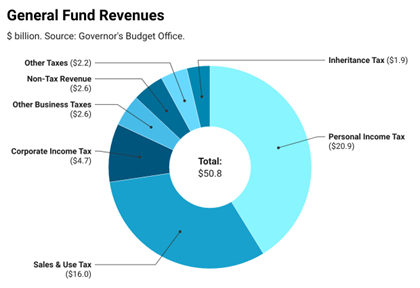
Figure 2
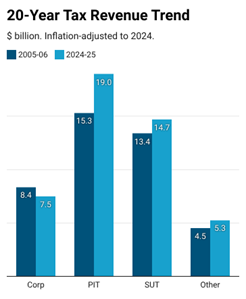
Figure 3
Structural Budget Deficit: The governor proposes transferring $4.7 billion from the Rainy Day Fund – reducing its balance to $3.3 billion – with $100 million dedicated to a new Federal Response Fund to offset declining federal assistance and the remainder deposited in the General Fund. The state’s revenues are projected to grow more slowly than what it spends on state services. There are solutions that would raise significant revenue by taxing individuals and entities with the most ability to pay, such as:
- Combined Reporting: Closing corporate profit-shifting loopholes by taxing multistate groups together boosts what corporations pay by billions.
- Fair Share Tax: The Fair Share Tax would bifurcate the Personal Income Tax and would lower Pennsylvania’s wage tax, while increasing taxes on income from wealth. This would raise billions while helping most households pay for essentials and save for future expenses.
- A Market-Driven Severance Tax: Over the period 2012 to 2025, a tax similar to the Texas severance tax would have raised another $13 billion over Pennsylvania’s current paltry impact fee. Many fees expire in 2027.
- A $15 per hour minimum wage by 2026 would reduce caseloads for assistance officers and raise the wages of 865,600 PA workers, shown in a county breakdown here.
A PDF of this document is available here.