This blog draws partly from Keystone Research Center’s “State of Working Pennsylvania 2024,” accessible at https://keystoneresearch.org/2024-state-of-working-pennsylvania-resource-page/
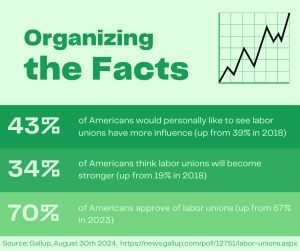
Each year, right before Labor Day, Gallup releases poll results about what Americans think of unions. This year’s poll came out on Friday, August 30. The results revealed that Americans strongly support unions. A growing share believe that increasing union strength would benefit the economy as a whole and that unions are increasingly likely to enjoy a comeback.
In recent years, two-thirds or more of Americans surveyed by Gallup report that they approve of labor unions—67% in 2023 and 70% in 2024. In Pennsylvania and nationally, rising union approval ratings have been accompanied by improving trends in union coverage. In Pennsylvania in 2023, overall union coverage rose more than half a percentage point to 14.2%.
As Americans think about the future, a record high 34% percent of them think that labor unions will become stronger than they are today. This is nearly double the 19% in 2018 (the last time this question was asked) and well above 25%, the previous peak (this question has been asked 17 times beginning in 1999). In addition, 43% of Americans would personally like labor unions to have more influence than they have today (another record high on a question first asked in 1999). Over six in 10 of Americans (61%) think that labor unions “mostly benefit” “the U.S. economy in general,” nearly twice the 36% share who think unions “mostly hurt” the economy.
The margin of support for unions grew larger when Gallup asked about specific labor-management disputes: 72% of Americans sympathize with television and film writers versus 19% with studios; 75% sympathize with the United Auto Workers union versus 19% with U.S. auto companies.
Support for unions, a positive outlook on their future, and a desire to see union influence grow partly reflect the nature and the scale of recent organizing. This organizing is turning the idea of a union resurgence from an abstraction into a concrete possibility, one that more and more people welcome.
KRC highlights two aspects of recent organizing that are helping more Americans see that they could lead to a big uptick in union membership and power.
First, a lot of union growth today occurs in inherently local service industries that cannot relocate because they have to stay near their customers. In Pennsylvania, union membership in the broad service sector saw a 64,000 increase in union membership in 2023 alone. Across the state, a cross-section of service workers became part of Pennsylvania’s labor movement: baristas, bakers, porters, drivers, warehouse workers, museum staff, nurses, therapists, child advocates, dispensary staff, and more. Because non-mobile industries are a huge share of our economy today, and capital flight is not an option, they could bring U.S. union density back towards the 35% peak reached in the 1950s. Any time unions in non-mobile industries gain a big share of the market in a geographical area, they can raise wages, benefits, and working conditions even if they have no presence in some other geographical areas.
A second key aspect of recent organizing that leads more Americans to believe a union comeback could happen: organizing in the giants of the modern service economy. A breakthrough took place on that front in February 2024 when Starbucks agreed to negotiate a “framework agreement” with the Service Employees International Union. The two parties are currently in collective bargaining.
Organizing in non-mobile services and in giants of the American economy are complementary developments that reinforce each other on the ground. In Philadelphia, for example, KRC’s researchers have identified a “contagion effect” as union elections have clustered together recently in university labs, libraries, and other non-profits. Workers interviewed in these locally rooted jobs often credit Starbucks workers with having inspired organizing also among non-coffee shop service workers.
Union organizing efforts and public support for unions have also been bolstered by federal public policies in the past few years. These policies include pandemic relief, and investment in infrastructure, climate, and innovation, which brought jobs and low unemployment back quickly after the pandemic recession. These policies also include President Biden’s use of his executive authority—including appointments to the National Labor Relations board—and of the “bully pulpit” to strengthen workers’ freedom to unionize and to create more “good union jobs.”
Future public policies will also impact whether the Gallup poll this year turns out to foreshadow a bigger organizing wave or turns into a highwater mark that is followed by renewed pessimism about the future of unions.
What are the proposed future public policies of the two presidential parties that will impact the future of unions? The end of “The State of Working Pennsylvania” summarizes what those parties themselves say on this front, pulling from the two parties’ platforms. The Democratic Party platform details federal policies that could further enhance workers’ union rights. The Republican platform does not mention the word union. The Heritage Foundation “Project 2025 report,” seen as a detailed blueprint for a Republican presidential administration in 2025, promotes policies that would weaken unions.
Summing up, more-than-two-thirds of Americans support unions. We believe that is because Americans see unions as our best—we would say our only—shot at creating two essential ingredients for an American that works for all: (1) an equitable new economy and (2) balance in public policymaking between regular people, on one side, and corporations and the rich. Given those views, it may be of value for those same Americans to register the future policy choices on offer with respect to labor unions.
Keystone Research Center released its annual report on the economy “State of Working Pennsylvania 2024” on August 27th. This is the first of a series of blogs focused on smaller, more digestible, pieces of our report. To access the full report, including full references for this specific blog, and other “State of Working Pennsylvania” resources, please visit our 2024 State of Working Pennsylvania Resource page here: https://keystoneresearch.org/2024-state-of-working-pennsylvania-resource-page/