Employment and Wage Growth in New York & New Jersey Outpace Pennsylvania Border Counties
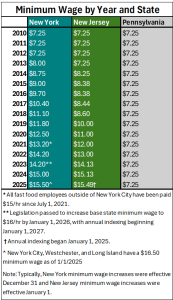
Pennsylvania’s minimum wage is currently $7.25 per hour. The commonwealth remains alone in the region, as all the states bordering Pennsylvania have raised their minimum wage—and many have raised it substantially and committed to further regular increases. Pennsylvanians can look across the state border and see workers in similar jobs earning at least $10.70 per hour (Ohio), $15.00 per hour (Maryland and Delaware), $15.49 per hour (New Jersey) and $15.50 per hour (New York). New Jersey, New York, and Ohio all have incorporated yearly cost of living increases into their minimum wage law so that workers are protected in the future and so that lawmakers don’t have to revisit the topic year after year.
Figure 1: Minimum Wage Schedule by State
In 2019, researchers at the Federal Reserve Bank of New York looked at the differences in minimum wage policies in New York and Pennsylvania, and the consequences of those differences. New York had been increasing its state minimum wage annually for more than five years at that point, while Pennsylvania’s minimum wage remained (and still remains) stuck at $7.25. This policy difference between states offered researchers a “natural experiment” because they could examine trends under two different policy regimes in two groups of geographically contiguous and otherwise alike counties (both rural with similar demographics and industry compositions). More specifically, the Federal Reserve Bank researchers could compare employment and wage trends in low-wage industries in “southern tier” NY border counties and in “northern tier” Pennsylvania border counties.
The Federal Reserve Bank research conclusion was clear: as New York raised its minimum wage, average wages increased but there was “no discernable effect on employment” in low-wage industries most impacted by a minimum wage increase. A robust and extensive body of prior minimum wage research reaches similar conclusions, including a recent review of 88 prior studies published online by the National Bureau of Economic Research (NBER). The NBER study showed that most minimum wage studies find no job losses or only small effects on total work hours or employment. Since the original Federal Reserve Bank of New York study, Keystone Research Center has periodically updated the analysis to continue to track the comparison.
In this blog, we compare employment and wages in the leisure and hospitality service sector for PA counties that border counties in New Jersey as well as New York. The leisure and hospitality sector includes arts, entertainment, recreation, accommodation, and food service work—many jobs with low pay that would be impacted by a minimum wage increase. We expand the original New York/Pennsylvania analysis to include a comparison with New Jersey because both New York and New Jersey pay a minimum wage that is over double PA’s current minimum wage, and both states have raised their minimum wages 11 or more times since the federal minimum wage reached $7.25 in 2009.
For the New York analysis, we compare leisure and hospitality employment and average weekly wages in the border county region of Chautauqua, Cattaraugus, Allegany, Steuben, Chemung, Tioga, Broome, Delaware, Sullivan, and Orange counties, to employment and average wages in PA border counties of Erie, Warren, McKean, Potter, Tioga, Bradford, Susquehanna, Wayne, and Pike. For the New Jersey analysis, we compare leisure and hospitality data from the border counties Burlington, Camden, Gloucester, Hunterdon, Mercer, Sussex, and Warren with PA border county employment and wage data from Bucks, Delaware, Monroe, Northampton, Philadelphia, and Pike counties (Figure 2).
Figure 2: Map of County Comparisons
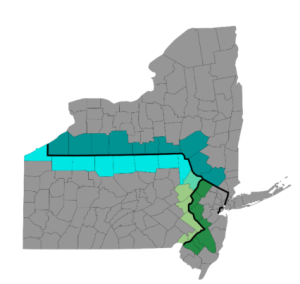
Note: Due to its location, Pike County is used in both the New York and New Jersey comparison analyses. The map was created with mapchart.net.
New York and Pennsylvania
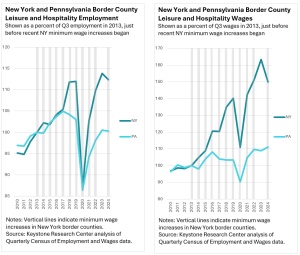
Leisure and hospitality employment growth in New York far outpaced Pennsylvania’s throughout New York’s scheduled minimum wage increases, the reverse of what critics of minimum wage increases predict. Figure 3 shows that New York’s leisure and hospitality employment recovered from COVID-19’s disruption much faster than did Pennsylvania’s in the border county region, and it continues to outpace Pennsylvania’s employment in this industry.
Turning to weekly wage growth, we find a substantial gap between New York border county wages and their Pennsylvania counterparts—and in the direction supporters of minimum wage increases would expect. Since 2013, leisure and hospitality wages grew faster in New York than in Pennsylvania. Leisure and hospitality wages rose 50% for New York workers over the full 2013 to 2024 period (Figure 4), far above Pennsylvania’s meager 11% leisure and hospitality wage growth over the same time. New York border county leisure and hospitality workers earned an average of $73 a week more than their Pennsylvania counterparts in Q3 2024, a $3,796 yearly difference for someone who is employed year-round.
Figures 3 and 4: New York and Pennsylvania Border County Leisure and Hospitality Employment (3) and Wages (4)
New Jersey and Pennsylvania
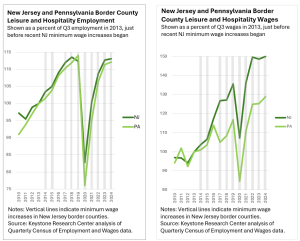
New Jersey and Pennsylvania border counties show similar employment changes in the decade-plus covered in this analysis, with New Jersey leisure and hospitality employment growth slightly outpacing Pennsylvania’s. While both areas experienced a significant employment dip during the COVID-19 pandemic, New Jersey’s employment didn’t drop as much, and its job growth has slightly outpaced PA’s yearly since 2020. New Jersey’s employment levels now exceed 2013 levels by 13%, almost identical to Pennsylvania’s 12% growth. Despite similar employment growth trajectories, these border areas differ significantly in their wage growth during this period. Although wages are higher in the Pennsylvania border county group because Philadelphia County’s high pay and worker density drive up the average, the data still show that New Jersey’s border counties experienced faster wage growth since 2013. Between 2013 and 2024, wages in the leisure and hospitality sector increased by 50% in New Jersey but only 29% in Pennsylvania. Even with a minimum wage more than double Pennsylvania’s, New Jersey has seen much stronger leisure and hospitality wage growth in these border counties.
Figures 5 and 6: New Jersey and Pennsylvania Border County Leisure and Hospitality Employment (5) and Wages (6)

Conclusion
The results of our updated analysis reveal no surprises to those who have followed the minimum wage debate in Pennsylvania and across the country. The data consistently show that—among a host of other benefits—minimum wage increases put money into the pockets of low-wage workers, lift families out of poverty, improve well-being, and increase worker productivity. Our estimates show that around one million PA workers would see their wages rise if PA’s minimum wage increased to $15 per hour, a wage still below New York and New Jersey’s current minimum wages.