How Leo XIII and Rerum Novarum Continue to Shape the Modern Labor Movement
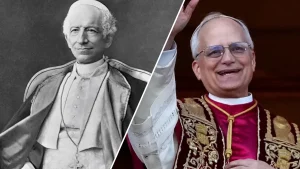
May 8th: 2025 – “Habemus Papam!” (We have a Pope!) bellowed Cardinal Mamberti from the Loggia overlooking St. Peter’s Square in Rome. White smoke had issued from the chimney of the Sistine Chapel, indicating the College of Cardinals had made their pick. Moments later, a beaming Robert Cardinal Prevost of Dolton, Illinois appeared before the crowd, freshly attired in the Papal red and white. The first American Pontiff and the 267th Pope, Prevost took the Papal name of Leo XIV. For those of us who follow such things, the name Pope Leo has a deep meaning for the world of labor.
The New Things of Leo XIII
“Let the working man and the employer make free agreements, and in particular let them agree freely as to the wages; nevertheless, there underlies a dictate of natural justice more imperious and ancient than any bargain between man and man… to wit, that remuneration ought to be sufficient to support a frugal and well-behaved wage-earner.” (¶ 45)
In the time of the previous Pope Leo – Leo XIII (born Gioacchino “Gio” Pecci, 1810) – the world was very different and yet quite the same. While leading the Catholic Church from 1878 until his death in 1903, Leo XII saw the church thrust into a modern world that his predecessors could hardly have imagined. That world was in the throes of the Industrial Revolution – rapid technological changes, massive urbanization, and vast social change. With the benefits of industry came severe social consequences. Workers of every age and gender toiled for hours in dangerous conditions for meager wages. Entire families lived in perpetual poverty despite every member working full time. Any type of labor organization was ruthlessly stamped out by increasingly rich and powerful robber barons – titans of industry who amassed wealth greater than the kings of old. The reaction to these new conditions was equally extreme. This was the age of Anarchism, Marxism, and violent resistance against unregulated, rapacious Capitalism. While his predecessor Popes had been happy to stay in their lane of theology, Pope Leo XIII saw a chance for the church to do material good.
“The most important of all are workingmen’s unions… associations of every kind are now far more common than formerly, and… they aim at helping each individual member to better his condition, both morally and materially.” (¶ 49)
In 1891, Rerum Novarum (Of New Things, or Of Great Change) was published, with the subtitle “The Rights and Duties of Capital and Labor.” In this Papal Encyclical, Leo XIII outlined the Church’s vision of a just society rooted in the dignity of work and the rights and moral responsibilities of the employer, of the worker, and of the state. For the worker, the Church affirmed and demanded that workers be paid fair wages, be provided with safe working conditions, and have the right to form unions and collectively bargain. Leo even asserted that if an employer failed to provide these things, it was grounds for excommunication from the Church.
“The first and most fundamental principle… if it be faithfully observed, will bring about much improvement and relief, is this: that private ownership must be held sacred and inviolable.” (¶ 46)”
At the same time, to counter the rise of Communism and Anarchism, Rerum Novarum also reiterated the right to private property, provided that right were balanced against the common good. Leo rejected both unregulated capitalism, which exploits workers by extracting excess value, and socialism, which seeks to abolish property altogether. Instead, the Church saw a middle path in which the state plays a role in protecting both the vulnerable and the right to property – while ensuring that economic systems are geared toward human flourishing, not simply toward profit.
“The main tenet of socialism, community of goods, must be utterly rejected, since it only injures those whom it would seem meant to benefit…” (¶ 15)
The Modern World of Leo XIV
The New World that will greet the Papacy of Leo XIV (born 1955) has many circumstances similar to the world of Leo XIII. The same forces that threatened the worker in 1891 remain a threat to the dignity and livelihoods of working people today. Pope Leo XIV has gone on record that the reality of this new industrial revolution played a role in his choice of papal name, picking up the torch laid down by Leo XIII more than a hundred years before.
Fortunately, the social teaching laid out in Rerum Novarum still applies today. “In our own day, the Church offers to everyone the treasury of her social teaching in response to another industrial revolution and to developments in the field of artificial intelligence that pose new challenges for the defense of human dignity, justice and labor,” today’s Pope Leo said in a recent address, citing his predecessor’s seminal work on the importance of putting humanity before capital. Pope Leo XIV’s choice of name has signaled that he sees the current situation not just as a technical and ideological challenge, but as a profoundly moral one. During his time in Peru, then Bishop Prevost made it clear that he saw the personhood and dignity of every human being as fundamental to the Church’s theology – and that the church has a duty to protect and advocate for the working man at all costs.
In choosing the name Leo, the Pope has done more than pay lip service to his predecessor. He has signaled a revival of a moral vision for labor in a time of profound change. Just as Leo XIII responded to the upheavals of the industrial revolution with a bold affirmation of human dignity, Leo XIV faces a new kind of industrial revolution. Rather than steam, gasoline, and whirring dynamos, this industrial revolution is algorithms, automation, and artificial intelligence, combined with an economic model that has even less regard for ethics. Fortunately, Rerum Novarum reminds us that progress that comes at the cost of the workers’ livelihoods and sense of purpose is not progress at all. Leo XIV calls us to confront our moment not with fear, but with moral clarity. The Church must follow the spirit of Rerum Novarum and challenge the powerful, demanding an economy that serves its people, not the reverse.
As a new Papacy begins, the torch lit by Leo XIII passes from one industrial age to the next, lighting a path forward into a world of new challenges for working people, offering insight, comfort, and assurance in our mission.
Read KRC and ReImagine’s latest paper, “If You Fund It They Will Come” HERE