Why We Need a $15 Per Hour Minimum Wage with SNAP’s New Work Requirements
New eligibility rules took effect for the Supplemental Nutrition Assistance Program (SNAP) on September 1, 2025, and will become more restrictive in coming months. Similar Medicaid changes are scheduled to follow in late 2026. These sweeping federal changes now being implemented at the state level mark a major shift in how low-income Americans access essential food support, and soon, healthcare support.
The stated intent seems straightforward: if you are an able-bodied adult without a special exception, you must now work 20 hours per week (80 per month) to receive SNAP. Supporters say it promotes self-sufficiency. The evidence shows it does not. Many recipients already work, and on their own, work requirements rarely lead to long-term employment gains. Instead, these new rules reduce safety-net participation by shifting people out of benefits rather than into jobs. Ultimately, many families experiencing hardship—including those who are still eligible for support—will lose assistance due to administrative issues, unstable jobs, or other barriers more commonly faced by low-income families. Pennsylvania Department of Human Services (DHS) estimates that 144,000 Pennsylvanians will lose SNAP because of these new rules.
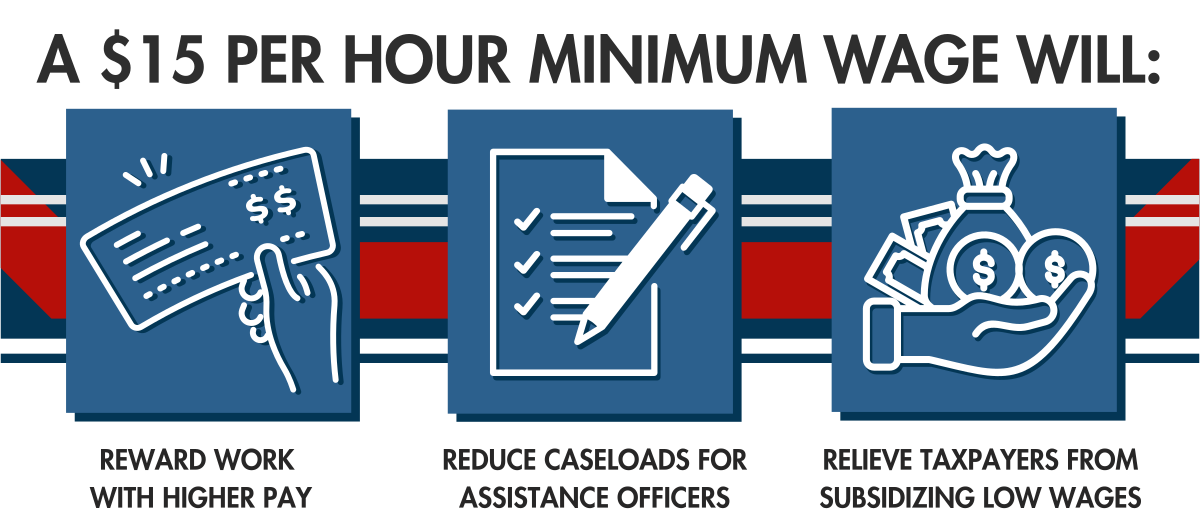
But Pennsylvania lawmakers have a big opportunity. If they want new SNAP work requirements to help alleviate some hardship rather than primarily push struggling families off nutritional support, they can raise Pennsylvania’s minimum wage. By pairing these new work requirements with a $15 per hour minimum wage, lawmakers can:
- Help SNAP recipients subject to the new rules earn more, instead of coercing them to take whatever job they can get at whatever wage.
- Support the Department of Human Services staff by reducing caseloads. A higher minimum wage means that more people earn out of SNAP/Medicaid eligibility, shrink caseloads, and give existing staff a fighting chance to manage the rest.
- Spare taxpayers from subsidizing employers who pay wages so low that workers still rely on public assistance.
Even with a higher minimum wage, work requirements remain a blunt instrument. With a $15 per hour minimum wage, they are at least less damaging.
 Work Requirements Alone Fall Short:
Work requirements for safety-net support aren’t a new policy. They’ve been implemented repeatedly in many forms across different states and programs. Recently, Arkansas (2018) and Georgia (2023) launched work requirements for Medicaid coverage. The results were clear—in Arkansas, thousands of people lost healthcare coverage, many of whom were still eligible but failed to navigate confusing and error-prone reporting systems. Research found no corresponding increase in employment and ultimately, a federal court halted those work requirements because Arkansas DHS failed to show that the policy aligned with Medicaid’s primary objective: providing health coverage to low-income individuals.
In Georgia’s program, essentially an “opt-in” program for their alternative to Medicaid expansion, enrollment was far below the estimated number who they expected and who were eligible. Like Arkansas, assistance office staff and clients encountered significant administrative and structural barriers that limited its effectiveness. Ultimately, the program failed to meet its two main goals—expanding healthcare enrollment and increasing employment. In an effort to improve the program, Georgia modified it to require annual reporting rather than monthly reporting requirements and added additional qualifying work activities. Arkansas and Georgia offer cautionary examples. When work requirements hinge on constant system checks and documentation, then administration, not policy intent, drives outcomes.
For workers, these new rules mean longer waits, confusing paperwork, and potentially lost benefits. Pennsylvania’s DHS is already facing significant staffing challenges in its County Assistance Offices (CAOs). Advocates and workers expressed concerns that the staffing levels are inadequate to handle prior caseloads and are woefully inadequate to handle an increase in workload. With $130 million in SNAP’s administrative costs looming on the horizon (October 1, 2026), delays and errors are almost certain. Without complementary reforms, the rollout of work requirements will exacerbate these problems and put food (and soon, healthcare) at risk for hundreds of thousands of Pennsylvanians.
A Low Minimum Wage with a High Cost
Pennsylvania’s $7.25 minimum wage is at the center of this challenge. This low wage doesn’t only harm the lowest-paid workers. Pennsylvania’s low minimum wage floor suppresses pay for nearly one million Pennsylvanian workers. Employers benefit disproportionately, while workers are left to cobble together multiple jobs or rely on assistance just to meet basic needs.  Pennsylvania is a regional outlier compared to neighboring states. New York, New Jersey, Delaware, Maryland, and Ohio have all raised their minimum wages significantly, in many cases to more than double the federal and Pennsylvania minimum wage. A Pennsylvanian working 40 hours a week, 52 weeks a year at $14.47 per hour (double Pennsylvania’s current minimum wage) earns below the living wage in every PA county and still qualifies for SNAP. As income rises, SNAP benefits phase out gradually, decreasing by about 24 to 36 cents for every additional dollar earned. Workers who earn more will see their SNAP benefits reduce or stop, always leaving families with higher net incomes. If the policy goal of work requirements is truly to promote independence, wages must be high enough for work to accomplish that.
There are also broader economic benefits. SNAP spending supports more than 12,000 grocery industry jobs in Pennsylvania and nearly 7,000 jobs in related industries such as agriculture, manufacturing, and transportation. When families lose benefits, those dollars vanish from local economies. Raising wages helps preserve consumer spending power and strengthens demand at neighborhood businesses.
Advocates and front line workers in Pennsylvania have been clear about the risks of implementing work requirements without parallel wage reforms. Many clients already work but face unstable schedules, lack reliable internet for reporting, or struggle to keep up with frequent recertification paperwork. Others qualify for exemptions—such as health limitations or care giving responsibilities—but are cut off before documentation can be processed. Those reentering the workforce now have less leverage than they did a year ago and may feel rushed into any job that meets requirements, regardless of conditions or pay.
Work requirements for SNAP are here, yet by themselves they are unlikely to lead to greater self-sufficiency. The path forward is clear: By raising the minimum wage to at least $15 per hour, Pennsylvania can align work requirements with fair pay, reduce administrative strain, and ensure that employment better provides a route out of poverty. A higher wage floor will reward work, strengthen families, and support local economies. If work requirements are mandatory, they must be paired with this protection. Anything less leaves Pennsylvanians worse off, not better.