Residential Property Tax Rates Are on the Rise. What About the Big Five?
Updated Estimates of the Property and Payroll Tax Exemptions of the Big Five Nonprofits
A PDF of this report is available here
On January 29, 2026, in his first month in office, Mayor O’Connor announced that the city had reached an agreement with the University of Pittsburgh Medical Center (UPMC) to provide a one-time payment of $10 million for new ambulances. UPMC is Pittsburgh’s largest employer and the owner of the greatest number of tax-exempt properties in the city and Allegheny County. The $10 million contribution was well-received and “significant,” as City Controller Heisler said, given the city’s financial stress and its aging fleet of vehicles.[1] This UPMC donation is a welcome one-time payment, but it also falls far below what UPMC would owe in property taxes (and in Pittsburgh, payroll taxes) every year if it was subject to taxes like for-profit companies.
The UPMC donation is a welcome starting point but highlights the need to consider that large nonprofits depend heavily on local infrastructure, but the community benefits and the unpredictable (but welcome) large donations they provide don’t nearly equal the size of their tax-exempt benefits. How do we move the Big Five nonprofits (University of Pittsburgh Medical Center, Allegheny Health Network, University of Pittsburgh, Carnegie Mellon, and Duquesne) toward making regular, reliable payments that local governments (who maintain the resources and infrastructure they heavily rely on) can depend? As it stands, residents across the city and county face a higher tax burden to maintain the resources that these large nonprofits rely on. The city, county, and school district have all recently had to raise property tax rates to close budgetary gaps and pay for human services, police, teachers, and more.
Pittsburghers have long wanted a more systematic solution to large nonprofits’ limited contributions toward city services. Administrations dating back decades have, with limited success, tried to get large nonprofits to consistently contribute to the very systems they depend on to operate.[2] Other cities, such as Boston, Erie, Providence, and New Haven have successfully established programs to ensure that large nonprofits contribute regularly to those cities’ well-being and operations. Some of these agreements are new, but the agreements in Erie are 30+ years old and are agreements honored by two of Pittsburgh’s Big Five—UPMC and AHN. Yet no such program exists in Pittsburgh.
UPMC is the largest of our region’s “Big Five” nonprofits within the region’s thriving education and medicine (“eds and meds”) sectors. The “Big Five” include the health care giants UPMC and Highmark/Allegheny Health Network (AHN) and the three largest educational institutions—University of Pittsburgh, Carnegie Mellon, and Duquesne University. All five of these entities own significant property in the city and some in the county but are exempt from paying most property taxes.[3]
The need for additional revenue from large tax-exempt institutions is becoming more urgent. The city faces sustained financial pressure due to significant changes in the real estate tax base. A 2022 court ruling reduced the Common Level Ratio for tax appeal cases in Allegheny County, an obscure yet significant calculation that has led to an increase in successful tax appeals by commercial property owners.[4] As a result, many for-profit entities now pay less in property taxes than they did in the past: they have used property tax appeals to lower their assessments to reflect lower commercial office building values following the post-COVID increase in telework and thus in commercial office building vacancy rates.[5]
These reduced property tax payments by commercial property owners have heavily strained local resources and services; residents in the city of Pittsburgh and Allegheny County have had to absorb more of the financial burden for public services through higher property taxes. Over the last 14 months, Allegheny County, the City of Pittsburgh, and the Pittsburgh School District have all increased their property tax rates to generate much-needed revenue. The tax increases mean residents will collectively pay $28 million per year to the city, $3.4 million to the Pittsburgh School District, and tens of millions of dollars per year to Allegheny County.[6] While residents shoulder the burden, the region’s largest non-profits continue to benefit from tax exemptions.
In May 2022, then Allegheny County Controller Tracy Royston and the City of Pittsburgh Controller, Michael E. Lamb, released a special report on Tax Exempt Properties. They estimated the revenue that the city and county lose due to nonprofit property tax exemptions.[7] We now provide updated estimates to reflect current property tax rates at the city, county, and school district levels.
Increased Property Tax Rates for Residents
Allegheny County, the City of Pittsburgh, and the Pittsburgh School District have all raised property taxes in the last 14 months.
- Allegheny County raised its property tax rate to 6.43 mills, up from 4.73, in December 2024.[8] Mills, or millage, is a measure for property taxes, which is the equivalent of $1 for every $1,000 of a property’s assessed value. This 36% increase in property tax rates in the county was slightly less than inflation since the last time the county raised property taxes, in 2013, in conjunction with the last countywide assessment.[9]
- The city of Pittsburgh raised its property taxes by 20% in December 2025, from 8.06 mills to 9.67 mills.[10]
- The Pittsburgh School District raised its taxes by 2% for its 2026 budget, from 10.25 mills to 10.457 mills.[11]
Altogether, Pittsburgh’s homeowners have seen a 3.5 mill and 15% combined increase in property taxes (city, county, plus school district) over the last 14 months, after a long period of stability.[12]
The city’s nonprofits also do not pay two recently established property taxes: the City of Pittsburgh began collecting a parks tax (0.5 mills) in 2021 to provide a dedicated revenue source for the city’s parks. The city established a library tax in 2012 that remains today at the original 0.25 mills.
New Estimates on Exempt Property Taxes of the Big Five
There are thousands of nonprofits in the county exempt from paying property taxes, but the five largest nonprofits hold the most valuable property. According to the 2022 report by the City and County Controllers, these five entities accounted for over half of the total property tax exemption for nonprofits in the City plus County.[13] We have estimated an update to the total exempt property tax value for each of the five largest nonprofits in the county and city, as well as the estimated tax loss because of these exemptions. These estimates are based on publicly available data.[14]
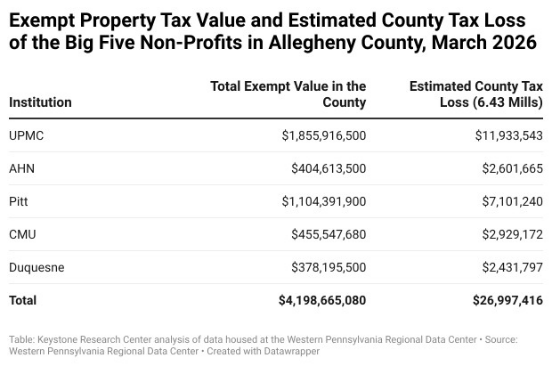
In Allegheny County, the Big Five hold exempt property worth an estimated $4.2 billion (see Table A). With a property tax rate of 6.43 mills, the county is losing an estimated $27 million per year because of the property tax exemptions of the five largest nonprofits. The University of Pittsburgh Medical Center (UPMC) owns the most property and has the highest total exempt value of any of the Big Five, $1.86 billion in the county. If it were not exempt, UPMC would owe the county $11.9 million per year. The University of Pittsburgh, which owns exempt property valued at $1.1 billion, would owe $7.1 million in county taxes per year.
Table A
The next table shows how much the city of Pittsburgh loses due to the Big Five’s exemption, which includes city government, Pittsburgh Public Schools, parks, and library taxes. The Big Five own exempt property in the city worth $3.8 billion and would owe $78.9 million per year to the City of Pittsburgh/Pittsburgh Public Schools if their properties were not exempt (see Table B). UPMC alone would owe a combined total of $34.6 million per year for city, city parks, library, and Pittsburgh Public School taxes; the University of Pittsburgh, $22.9 million.
Table B
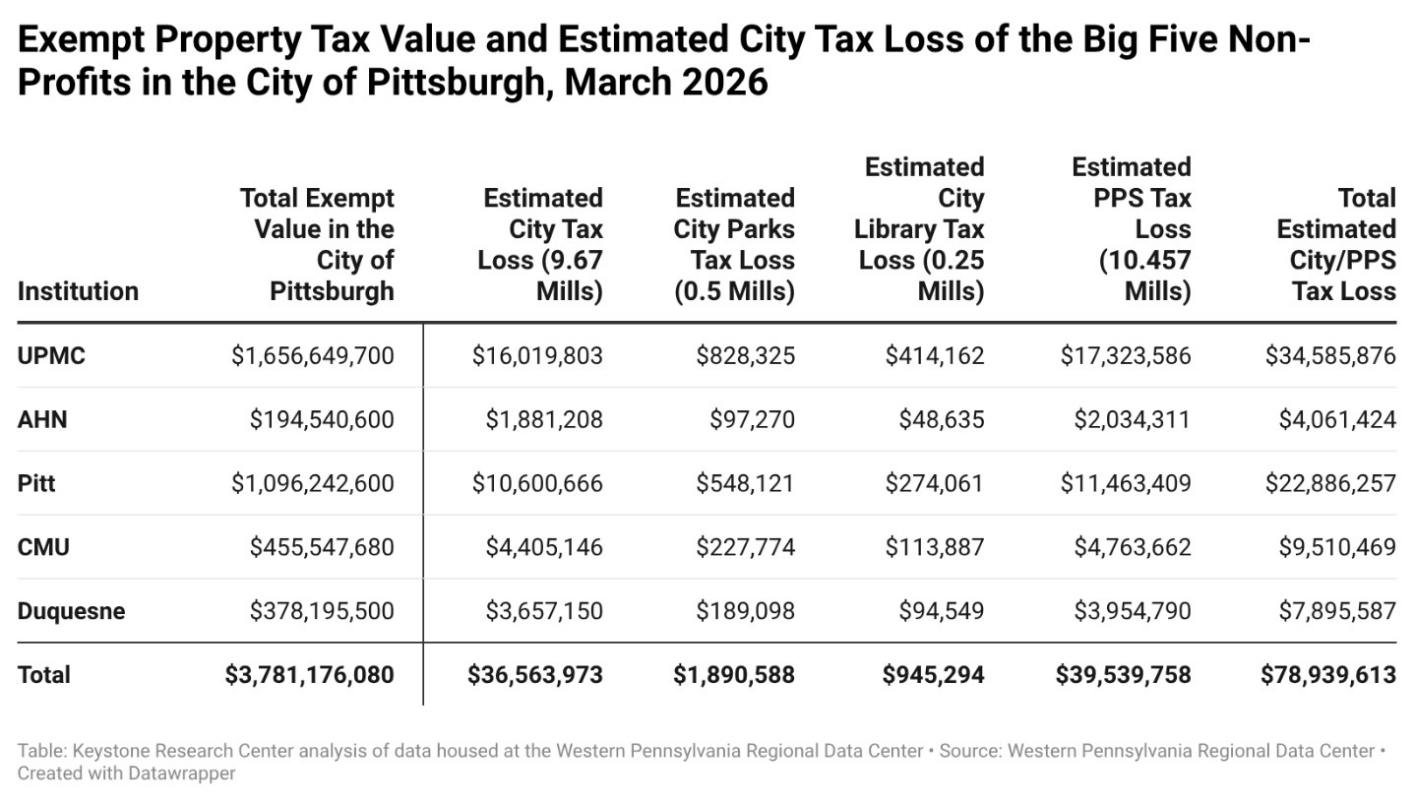
While residents in Allegheny County and the City of Pittsburgh face increased property taxes, the five largest nonprofits enjoy property tax exemptions totaling $105.9 million, including $27.0 million that would have been used in the county, $36.6 million in the city, and $39.5 million for Pittsburgh Public Schools.
The Big Five’s Tax-Exempt Status Also Shields Them from Paying the City of Pittsburgh’s Payroll Expense Tax
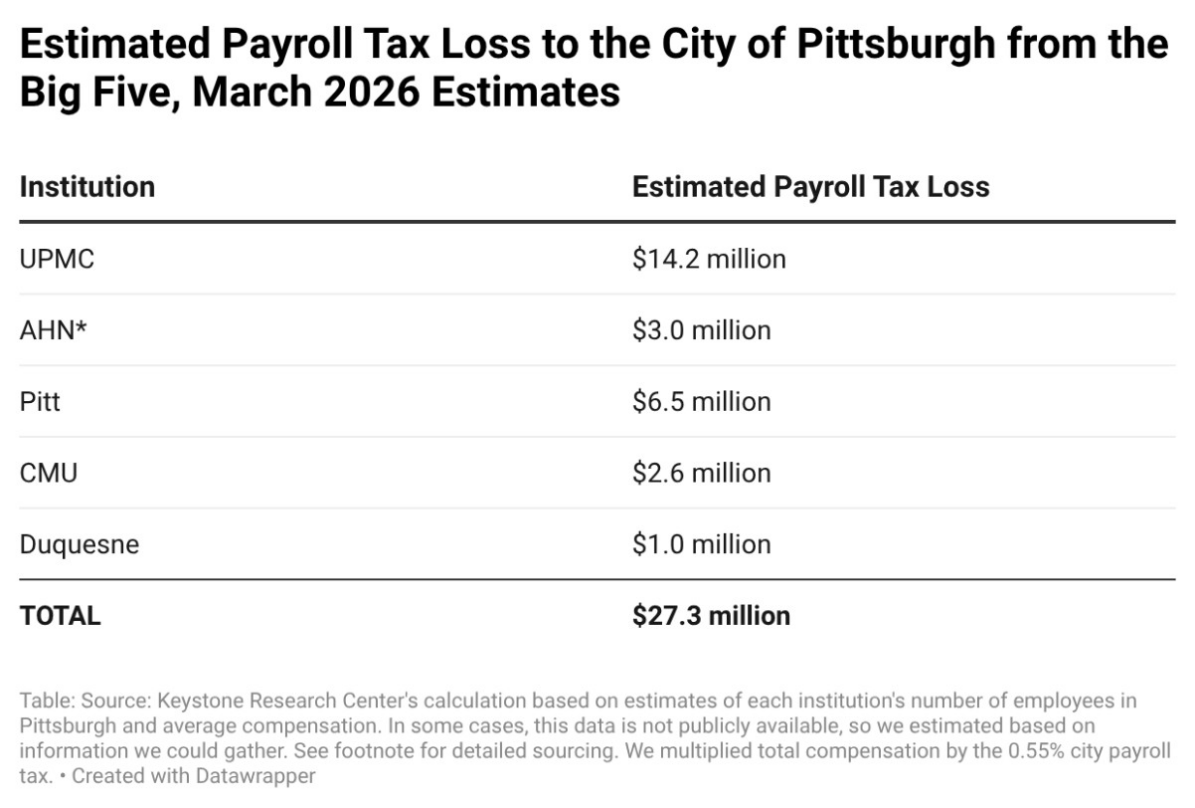
Property taxes aren’t the only city tax that the Big Five are shielded from paying due to their tax-exempt status as purely public charities. The City of Pittsburgh imposes a 0.55% tax on payroll amounts generated on business activities within the city limits.[1] Government entities and institutions of purely public charity are exempt, including the Big Five. While property taxes have received the most attention, the payroll tax loss, if paid by the Big Five, would close to double what would be owed in property taxes to the City of Pittsburgh.
We estimated the payroll tax loss for each of the Big Five institutions based on publicly available data. [15] While these are limited estimates, we believe they are in the ballpark of what each institution would owe based on its average compensation and the number of workers it employs in the city. We estimate that the Big Five would owe approximately $27.3 million in payroll taxes to the City of Pittsburgh each year if they were not exempt.
How Other Cities Ensure Large Nonprofits Make Notable Contributions
UPMC and other large nonprofits maintain that they should not pay property taxes because of their status as a “purely public charity.” But being a nonprofit does not always mean the organization spends more than for-profits on charity care. In fact, a 2021 Johns Hopkins University study found that nonprofit hospitals spend less on charity care than for-profit hospitals, and that nonprofits and for-profits spend similar amounts to cover Medicaid shortfalls.[16] A 2024 Lown Institute study found that 80% of 2,425 nonprofit hospitals spent less on charity care and community investments than the estimated value of their tax breaks. The study listed UPMC as having the sixth-highest health system “fair share deficit” nationally (defined as tax exemption minus spending on community benefits), at $578 million.[17]
To ensure that large nonprofits contribute fairly to local revenues, many localities have entered into agreements called “Payments in Lieu of Taxes,” or PILOT agreements, with large nonprofits. At their best, these agreements establish regular, long-term, and predictable payments, with clear expectations and public disclosure. These payments are typically significantly less than what large non-profits would owe in taxes if not exempt.
Erie, Pennsylvania: UPMC and AHN, two of Pittsburgh’s Big Five, have PILOTs in place in Erie, PA. In Erie, UPMC Hamot and AHN Saint Vincent hospitals pay roughly 50% of what they would owe in taxes. The PILOT dates back to the 1990s when these two independent hospitals had agreed to the PILOT deal. When UPMC and AHN took over the Erie hospitals in 2011 and 2013, respectively, they honored the existing agreement. Revenue from the PILOT is split among the city, the county, and the Erie school district.[18] As we will show below, a 50% PILOT with the Big Five in the City of Pittsburgh would bring in $33 million a year (50% of the total the Big Five would owe in city, parks, and payroll taxes), and $20 million a year to Pittsburgh Public Schools.
New Haven, Connecticut: In 2021, with Yale University’s endowment increasing and the city’s budget deficit growing, Yale increased its voluntary payment to the city. It had been paying $13 million but agreed to pay an additional $10 million for the following five years (for a total of $23 million a year), and an additional $2 million in the sixth year. All told, Yale’s contribution totaled an additional $52 million over six years. On a population basis, a yearly $23 million donation in New Haven is equivalent to $50 million in Pittsburgh. In addition, Yale contributed an additional $5 million for a center that focused on addressing inequality in the city. Yale also agreed to increase payments if it were to build more property.[19]
Boston, Massachusetts: Boston has long been considered a leader in negotiating equitable PILOT agreements. The city has a voluntary PILOT set at 25% of institutions’ tax liability, with credits for verified community benefits and public disclosure of adherence to the plan. The city of Boston makes public the city’s requested amount and each institution’s compliance, promoting public accountability. But, because the plan is voluntary, nonprofits often pay below the city’s ask. For example, in 2024, the city requested more than $128 million and received around $35 million in cash payments (more in community benefit credits).[20] On January 30, 2026, Boston announced that Northeastern University had committed to increasing its payments to the city by nearly 40% (from $1.9 million to $2.6 million).[21]
Providence, Rhode Island: In 2023, Providence and four local universities (Brown, the Rhode Island School of Design, Providence College, and Johnson and Wales University) created a memorandum of understanding whereby the universities agreed to pay $177 million in voluntary payments to the city over the course of 20 years, as well as community contributions, which are other cash or in-kind services to the city and its residents. Brown also signed a separate agreement with the city to provide an additional $46 million on top of the MOU. The MOU more than doubled the voluntary payments that Providence was receiving from these four universities.[22] Adjusting for population, the commitments of these four universities in Providence are equivalent to $18 million per year in Pittsburgh.
Potential Yearly PILOT Revenue from the Big Five
The Big Five nonprofits operating in the Pittsburgh area could significantly improve the financial picture for Allegheny County and the City of Pittsburgh. If PILOTs were established for UPMC, AHN, the University of Pittsburgh, Carnegie Mellon University, and Duquesne University, the city and county could rely on significant, yearly revenue from these institutions, which benefit from city services like police, fire, and other public services, as well as prime real estate.
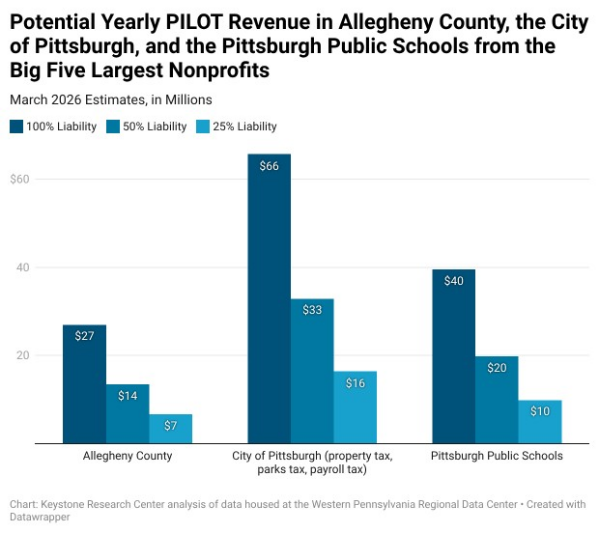
Figure A shows how much the City of Pittsburgh and Allegheny County would receive in PILOT payments at 100%, 50%, and 25% tax liability. A PILOT deal for the City of Pittsburgh at 100% of the Big Five’s tax liability would bring in an additional $66 million in revenue to the city’s general fund—$36.6 million for city property tax, $1.9 million for city parks, and $27.3 million for payroll tax (and we did not include the library tax because this would go directly to the Carnegie Library). Fifty percent would bring in $33 million a year; and a 25% PILOT would bring in $16 million a year (see Figure A). In Allegheny County, a PILOT deal at 100% of tax liability would bring in an additional $27 million. At 50% of tax liability it would bring in $14 million. The Pittsburgh Public Schools could see an additional $40 million in funds at 100% liability—$20 million at 50%. All told, 100% liability for all of these taxes from the Big Five would be $133 million per year to Allegheny County, Pittsburgh, and Pittsburgh Public Schools. At 50% liability, it would bring in $67 million annually. This would have a significant impact on our region.
Figure A
The Big Five Should Contribute Every Year, Just Like Residents Do
The announcement of UPMC’s $10 million payment to the city of Pittsburgh was welcome news. Ten million dollars is about 66% of UPMC’s property taxes owed ($15.9 million) to the city, 32% of its total tax exemption ($31 million) to the city of Pittsburgh (property, parks, and payroll taxes), and 16% of its total tax exemption in the region ($60.7 million) for 2026 alone if it wasn’t exempt.[23] But donations like this shouldn’t be a one-off. They should be reliable, annual sources of income from large institutions that have the means to contribute to the places where they reside and benefit from. These large nonprofits and the city and county in which they are embedded rely on each other to be successful. If the city and county are thriving, so will these institutions, and vice versa. It’s in the long-term interest of the Big Five to invest regularly in city and county government to make sure local government has the money to invest in all the things that make this a great place to live.
Regular and reliable contributions from the Big Five are essential to keep city and county services running as commercial property tax revenues erode, American Rescue Plan dollars expire, and federal support becomes less predictable and reliable. The city, county, and school districts have already asked residents to shoulder these pressures through higher property tax rates. Now it’s time for our region’s largest nonprofits to step up as well. UPMC took an important first step. Other nonprofits should step up, and all five plan to make yearly payments in lieu of taxes. We recommend that the City of Pittsburgh and Allegheny County regularly update and share with the public the amount of taxes the Big Five are exempt from. The city and county should also set clear annual PILOT targets for the Big Five and enforce accountability by requiring standardized reporting, publicly disclosing both the requested amounts and the payments made, as other cities do.
Appendix
The Common Level Ratio and Its Use in Lowering Property Tax Assessments
The Common Level Ratio (CLR) measures how much market value of a “typical” property in a county has risen since the county’s last property tax assessment. Technically, CLR equals the median value (expressed in percent) in a county of the ratio of assessed property value to current fair market value. The State Tax Equalization Board calculates STEB each year (for background on STEB, see https://dced.pa.gov/local-government/boards-committees/steb-ted-faq/). The CLR STEB’s “Policy and Procedures Manual for Common Level Ratio (CLR) (online at https://dced.pa.gov/download/steb-policy-procedures-manual-clr/?wpdmdl=79959&refresh=69aa0531562f41772750129) defines how to define the CLR. For current CLRs for every county, see https://dced.pa.gov/download/common-level-ratio-2024/?wpdmdl=127098&refresh=6977f2e457fb71769468644.
Since many counties only conduct property tax assessments occasionally, including Allegheny County (which last assessed properties in 2012), and market values keep rising, the CLR is generally less than 100 percent. The CLR currently in Allegheny County (that will apply through June 30, 2026) is 50.14 (i.e., percent). That means, in effect, that the market value of the median property has roughly doubled since the 2012 assessment (based on 2011 data). In Allegheny County, if the market value of a specific parcel of property has not risen as much as typical (i.e., has not doubled), or has fallen recently, its CLR will be above 50.14. For example, many commercial office buildings have recently lost market value due to increased working from home since the pandemic. Suppose the market value of a specific office building has only risen a third since the 2012 Allegheny County assessment, from $10 million to $13.33 million. That means its CLR is 75 ($1 million divided by $1.33 million). That means the property owner is paying property taxes on 75% of its market value rather than the 50% of market value on which typical Allegheny County properties pay property taxes. A big positive difference between a parcel’s CLR and the CLR for a county makes challenges to the parcel’s assessment more likely to succeed, leading to a downward adjustment in its property taxes. A challenge for the county (and for other counties where commercial office buildings have been challenged in their assessed values) is that there is no automatic mechanism by which parcels that have risen in market value by more than the typical amount since the last reassessment pay more in property taxes.
[1] Charlie Wolfson, “UPMC to give Pittsburgh $10 million for new ambulances.” Pittsburgh’s Public Source, January 29, 2026. Accessed at: https://www.publicsource.org/upmc-gifts-pittsburgh-millions-new-ambulances/
[2] For a detailed discussion of past administrations efforts, see Tracy Royston, Lou Takacs, Rob Cullen, Michael E. Lamb, Rachael Heisler, Mark Ptak, “Special Report: Tax-Exempt Properties.” Office of the County Controller (Allegheny County) and Office of City Controller (City of Pittsburgh), May 2022. Accessed at: https://www.pittsburghpa.gov/files/assets/city/v/1/controller/documents/20827_tax-exempt_properties_special_report_1.pdf.
[3] As of 2021, the Big Five paid property taxes on about 7% of their assessed value in the city and about 11% in the county. Under Pennsylvania’s constitution, property taxes are exempt for “institutions of purely public charity” if that property is regularly used for charitable purposes. See Tracy Royston, Lou Takacs, Rob Cullen, Michael E. Lamb, Rachael Heisler, Mark Ptak, “Special Report: Tax-Exempt Properties.” Office of the County Controller (Allegheny County) and Office of City Controller (City of Pittsburgh), May 2022. Accessed at: https://www.pittsburghpa.gov/files/assets/city/v/1/controller/documents/20827_tax-exempt_properties_special_report_1.pdf.
[4] Hal D. Coffey, Joshua M. Farber, Adam Ventura, “Allegheny County Property Owners Can Challenge 2022 and 2023 Taxes.” Clark Hill, February 10, 2023. Accessed at: https://www.clarkhill.com/news-events/news/allegheny-county-property-owners-can-challenge-2022-and-2023-taxes/
[5] See Appendix for more information on the Common Level Ratio.
[6] Julia Burdelski, “Pittsburgh City Council approves 2026 budget with 20% property tax increase.” TribLive, December 21, 2025. Accessed at: https://triblive.com/local/pittsburgh-city-council-to-vote-on-2026-budget-tax-hike/; Michael DiVittorio, “Pittsburgh Public Schools officials approve 2026 budget with 2% tax hike.” TribLive, December 17, 2025. Accessed at: https://triblive.com/local/pittsburgh-public-schools-officials-approve-2026-budget-with-2-tax-hike/
[7] Tracy Royston, Lou Takacs, Rob Cullen, Michael E. Lamb, Rachael Heisler, Mark Ptak, “Special Report: Tax-Exempt Properties.” Office of the County Controller (Allegheny County) and Office of City Controller (City of Pittsburgh), May 2022. Accessed at: https://www.pittsburghpa.gov/files/assets/city/v/1/controller/documents/20827_tax-exempt_properties_special_report_1.pdf
[8] Julia Zenkevich, “Allegheny County Council passes 2025 budget with ‘compromise’ 36% tax increase.” WESA, December 3, 2024. Accessed at: https://www.wesa.fm/politics-government/2024-12-03/innamorato-and-county-council-announce-budget-compromise-for-allegheny-county
[9] Inflation between 2013 and 2025, the year the new tax rate was first paid was 39% based on CPI-U downloadable from the Bureau of Labor Statistics at https://data.bls.gov/multi-screen?survey=cu.
[10] Patrick Doyle, “How much are your property taxes goings up in Pittsburgh in 2026? We have a calculator.” WESA, December 23, 2025. Accessed at: https://www.wesa.fm/politics-government/2025-12-23/pittsburgh-property-taxes-calculator
[11] DiVittorio, December 17, 2025. Accessed at: https://triblive.com/local/pittsburgh-public-schools-officials-approve-2026-budget-with-2-tax-hike/
[12] Charlie Wolfson, “Pittsburgh council approves 20% property tax hike.” Pittsburgh’s Public Source, December 23, 2025. Accessed at: https://www.publicsource.org/pittsburgh-council-property-tax-budget-vote/
[13] This is based on November 2021 data. In the County, the big five accounted for 46.7% of the nonprofit property exempt in Allegheny County and 63.4% of the nonprofit property exempt from taxes in the City of Pittsburgh. See Office of the County Controller and the Office of City Controller, Special Report: Tax-Exempt Properties, May 2022. Accessed at: https://www.pittsburghpa.gov/files/assets/city/v/1/controller/documents/20827_tax-exempt_properties_special_report_1.pdf.
[14] Parcel IDs for UPMC, Pitt, CMU, AHN, and Duquesne tax-exempt properties in the city of Pittsburgh and in Allegheny County were identified using 2022 data downloaded from the Allegheny controller webpage here: https://alleghenycontroller.com/wp-content/uploads/2022/09/Property-Owned-by-Largest-Nonprofits.xlsx. We compared these parcel IDs against more recent property assessment parcel data from the Western Pennsylvania Regional Data Center, available for download here: https://data.wprdc.org/dataset/property-assessments/resource/9a1c60bd-f9f7-4aba-aeb7-af8c3aaa44e5. Matching across datasets, we identified a final list of 408 properties in Allegheny County for this analysis. Due to data restrictions, this list reflects properties owned by these groups as recently as 2022, and while we are confident that our analysis of property value is conservative overall, any property that was purchased or sold since 2022 is not reflected/up to date in our data.
[15] For estimates on workforce size in the city of Pittsburgh, we used this factsheet from the Pittsburgh Regional Alliance: https://pittsburghregion.org/wp-content/uploads/2026/01/County-Profile-City-of-Pittsburgh-1.pdf, which uses U.S. Census Bureau data from 2025. This source did not break out employment estimates from AHN—it is embedded within the Highmark Health number. We found estimates from AHN of employment size for their two hospitals in Pittsburgh (Allegheny General and West Penn), found here: https://www.ahn.org/content/dam/ahn/en/dmxahn/documents/locations/allegheny-general-hospital/fast-facts-allegheny-general-hospital.pdf and here: https://www.ahn.org/content/dam/ahn/en/dmxahn/documents/locations/west-penn-hospital/fast-facts-west-penn-hospital.pdf. For average salaries, we used information from salary.com. UPMC source: https://www.salary.com/research/company/upmc-salary; AHN source: https://www.salary.com/research/company/allegheny-health-network-salary; University of Pittsburgh source: https://www.salary.com/research/company/university-of-pittsburgh-salary; CMU source: https://www.salary.com/research/company/carnegie-mellon-university-salary; Duquesne source: https://www.salary.com/research/company/duquesne-salary
[16] Ge Bai, Hossein Zare, Matther D. Eisenberg, Daniel Polsky, Gerald F. Anderson, “Analysis Suggests Government and Nonprofit Hospitals’ Charity Care Is Not Aligned with Their Favorable Tax Treatment.” Health Affairs, Vol. 40, No. 4, April 2021. Accessed at: https://www.healthaffairs.org/doi/10.1377/hlthaff.2020.01627
[17]Brittany Trang, “Some nonprofit hospitals spend less on charity care than they receive in tax breaks, new analysis shows.” Lown Institute, March 26, 2024. Accessed at: https://lowninstitute.org/in-the-news/some-nonprofit-hospitals-spend-less-on-charity-care-than-they-receive-in-tax-breaks-new-analysis-shows/; and Lown Institute “Fair Share Spending: Are hospitals giving back as much as they take?” 2024. Accessed at: https://lownhospitalsindex.org/hospital-fair-share-spending-2024/
[18] Charlie Wolfson, “Gainey wants Pittsburgh healthcare giants to pitch into the city budget. In Erie, they already do.” Pittsburgh’s Public Source, June 13, 2022. Accessed at: https://www.publicsource.org/erie-hospital-pilot-upmc-ahn-pittsburgh-gainey/
[19] Sai Rayala, Sylvan Lebrun. “City and University officials announce six-year commitment, increases to Yale’s voluntary contribution.” Yale Daily News, November 17, 2021. Accessed at: https://yaledailynews.com/articles/city-and-university-officials-announce-six-year-commitment-increases-yales-voluntary-contribution
[20] City of Boston, Payment in Lieu of Tax (PILOT) Program.” City of Boston. Accessed at: https://www.boston.gov/departments/assessing/payment-lieu-tax-pilot-program
[21] Catherine Carlock, “Facing budget crunch, Boston wants its universities to pay up.” Boston Globe, January 30, 2026. Accessed at: https://www.bostonglobe.com/2026/01/30/business/boston-universities-payments-budget/Sai Rayala and Sylvan Lebrun, “City and University officials announce six-year commitment, increases to Yale’s voluntary contribution.” Yale Daily News, November 17, 2021. Accessed at:
[22] Maya Kelly, Ciara Meyer. “Five takeaways from Providence’s PILOT agreements with local colleges and universities.” Brown Daily Herald, November 24, 2024. Accessed at: https://www.browndailyherald.com/article/2024/11/five-takeaways-from-providences-pilot-agreements-with-local-colleges-and-universities
[23] It’s important to note that it was reported that this $10 million donation will actually be spread over two years, so the percentages noted here would actually be cut in half. See Hallie Lauer. “Pittsburgh GOP calls for transparency in private gifts for emergency vehicle from UPMC, PNC Foundation to city.” Pittsburgh Post Gazette, February 19, 2026.